Shooting From the Hip
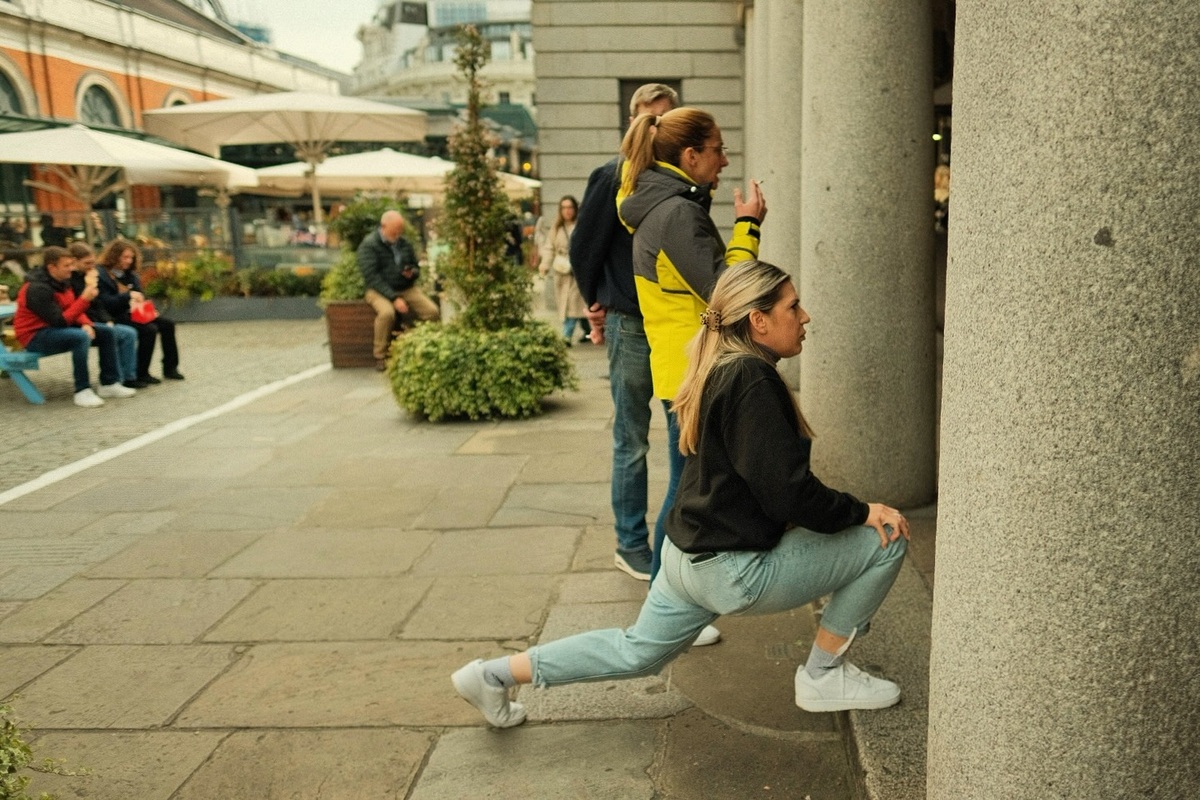
Photo: lukes.photos
Camera at waist height, zone focused (see zone focusing card), shooting blind or with a rough sense of aim. The goal is natural, unguarded moments - people who have no idea they're being photographed.
This is not a lazy technique. It requires spatial awareness, discipline about distance and timing, and a lot of editing afterwards.
Watch for: horizon tilt. More frames than you expect will be unusable. That's fine. You're playing a numbers game here.
Zone focus at 1.5–2m | Aperture: f/8 | Camera at waist height
Get the full deck — 150+ prompt cards with complete technique breakdowns, assignments, and camera settings. One purchase for lifetime access, a founding price for our first 50 members before it moves to a subscription.
Get the full deckWhat it is and why it works
Shooting from the hip means taking the frame without raising the camera to your eye — held at chest or waist height, or simply at your side, fired without looking through the viewfinder. The purpose is candour: the moment a camera comes up to the eye, people notice and change, and the natural scene you saw evaporates. Shot from the hip, the camera stays invisible and the moment stays real.
It also gives you a distinctive low, slightly wide perspective — looking up at subjects from waist level, the way children and dogs see the world — that separates these frames from the eye-level view everyone else shoots. Many classic candid photographs were made this way, and the technique remains one of the most useful in the street repertoire.
The settings that make it possible
Because you cannot focus through the viewfinder, you have to remove focus and exposure from the moment entirely. This is a zone-focus technique first and foremost.
Zone focus at a fixed distance. Set focus manually (or lock it with [back button focus](/cards/back-button-focus)) to around 2–3 metres, the natural distance for a candid street subject. See the [Zone Focus Distance Guide](/cards/zone-focus-distance-guide) for the exact distances.
Small aperture for a deep zone. f/8 to f/11 gives you a band of sharpness roughly from 1.5 to 4 metres, so anything in that range is sharp without focusing. This is the whole reason the technique works.
Fast shutter, Auto ISO. Keep 1/250 or faster to freeze walking subjects, and let Auto ISO hold it (see [Auto ISO Setup](/cards/auto-iso-setup)).
A wide-ish lens. 28mm or 35mm equivalent gives you margin for framing error — you can crop in later, and the wide angle's deep depth of field helps the zone focus.
Learning to frame without looking
Learn your lens's angle of view. With practice you develop an instinct for what a 28mm or 35mm takes in from hip height. Point the body, not your eye — aim the camera as an object.
Tilt up slightly. From waist level, the camera naturally points a touch downward; tilt the top of the camera back a few degrees to keep horizons and standing subjects in frame. This is the single most common correction.
Shoot wide and crop. Give yourself margin. Framing loosely and cropping to the final composition afterwards is not cheating — it is how the technique is meant to work.
Use the flip screen if you have one. A tilting rear screen held at waist level is the modern, more accurate version of hip shooting — you get a discreet low angle and can still see roughly what you are framing. Many street photographers use it as a halfway house.
Practise deliberately. Spend a session shooting only from the hip on a busy street. The framing instinct builds fast once you commit to it.
Ethics and common mistakes
It is legal, but be thoughtful. Shooting from the hip in public is entirely lawful (see our guide to [UK street photography law](/resources/uk-street-photography-law)), but not raising the camera can feel more surreptitious. The intent should be candour, not concealment — you are avoiding disturbing a natural moment, not sneaking pictures of people who would object. If someone notices and asks, be open and friendly, exactly as you would with any candid frame.
Wonky horizons. The commonest technical fault. A slight, consistent camera tilt throws every frame off; be aware of it and correct in the edit.
Cutting off heads and feet. Framing blind means misses. Shoot wider than you think and crop — the deep depth of field gives you the resolution room to do it.
Relying on it exclusively. Hip shooting is one tool, best for tight candid moments where raising the camera would kill the scene. For many frames, shooting openly at eye level is better. Use it as part of the repertoire, not the whole method.
Field Questions
What settings do you use to shoot from the hip?
Zone focus at 2–3 metres, a small aperture (f/8–f/11) for a deep band of sharpness, a fast shutter (1/250+) on Auto ISO, and a wide-ish lens (28–35mm equivalent). The deep depth of field is what lets you shoot sharp without focusing through the viewfinder.
Why do street photographers shoot from the hip?
To keep candid moments natural. Raising a camera to your eye makes people notice and change their behaviour; shooting from waist or chest height keeps the camera unobtrusive and the scene real. It also gives a distinctive low, slightly wide perspective.
How do you frame a shot without looking through the viewfinder?
Learn your lens's angle of view with practice, aim the camera body like an object, tilt it up slightly to counter the downward angle from waist height, and shoot wide so you can crop to the final composition afterwards. A tilting rear screen makes it more accurate.
Is shooting from the hip legal?
Yes, photographing people in public in the UK is legal whether or not you raise the camera. The intent should be to preserve a natural moment rather than to conceal — if someone notices and asks, be open and friendly, just as with any candid frame.